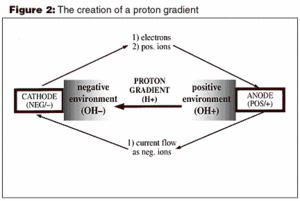
CellStimTM Therapy delivers a subtle alternating current waveform of specific frequencies to the tissue through pads placed over the area of injury. When absorbed, the tissue sets up a potential gradient where the negative cathode is an environment of negative hydroxyl ions (OH-). This is caused by electron interaction with water molecules at the cathode, hydrolyzing the water molecules into hydrogen and hydroxyl molecules. The same reaction takes place at the anode; however, because the anode is positive in polarity, protons (hydrogen ions) form the environment around the anode of the potential gradient.
In the instantaneous moment of each positive and negative pulse of the CellStimTM waveform, both hydrogen and hydroxyl ions are formed in the injured tissue. Over a few minutes of treatment time, the ionic environment becomes hydrogen and hydroxyl in the surrounding tissue which leads to the increased production of ATP. After CellStimTM Therapy is turned off, ATP production continues in the surrounding tissue for several hours.
This ATP formation can be explained through the chemosmotic theory of Mitchell. This theory explains how mitochondria form ATP by familiar processes such as the electron transport chain and Krebs cycle. In Mitchell’s theory, we see that ionized hydrogen (protons) trigger the electron transport chain by combining with NADH to form NADH+, as well as FAD to form FADH2 and other mediators. The net effect of each cycle of the electron transport chain is the introduction of six hydrogen ions in between the inner and outer mitochondrial membranes.
At this point, hydrogen ATPase is activated by the high intramembrane content of hydrogen and activates ATP production. This is accomplished by the addition of a phosphate group to ADP to form ATP (see Figure below, except note that the process will basically run in reverse to form ATP). This process is known as oxidative phosphorylation. The ATP is at this point transferred out of the mitochondria into the cytoplasm of the cell where it is stored until used for cellular processes.